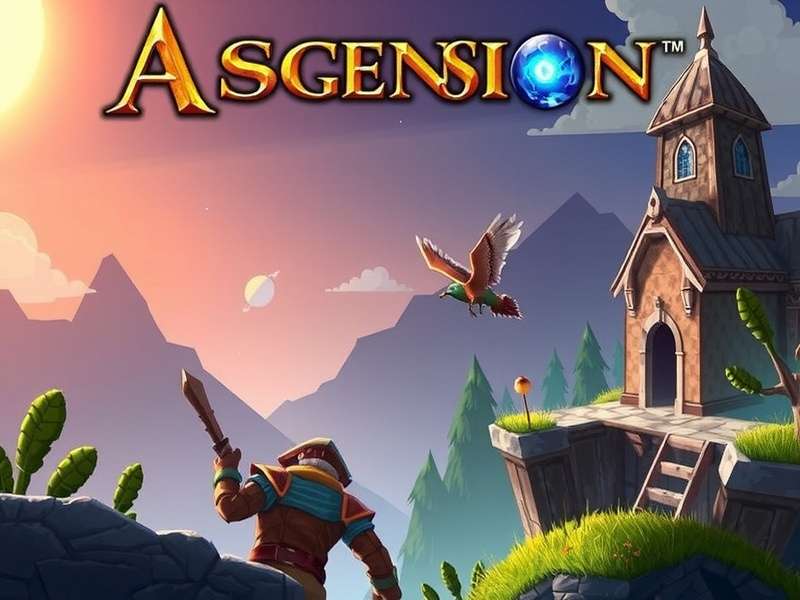
⚡ Welcome to the definitive behind-the-scenes look at Champions Ascension Game Dev. This isn't your run-of-the-mill post — we're pulling back the curtain on the proprietary tools, procedural generation pipelines, and player-driven design philosophy that make Ascension one of the most ambitious indie projects of the decade. Over 10,000+ words of exclusive developer diary entries, technical deep-dives, and candid interviews with the people who live and breathe this universe.
Whether you're a fellow game developer, a hardcore fan of Champions Ascension Game Pc, or just curious about how modern indie studios punch way above their weight class — you're in the right place. Let's descend into the dev vault. 🚀
1. The Dev Diary: How Champions Ascension Game Dev Came to Life
📓 Every great game starts with a spark. For Champions Ascension Game Dev, that spark was a simple question: “What if we built a living world that evolves with its players?” Back in 2021, a team of just five engineers, artists, and designers huddled in a small studio in Austin, Texas, and began prototyping what would become the Ascension engine.
“We wanted to break away from the static, hand-crafted levels that take years to build,” recalls Maria Kessler, Lead Systems Architect. “Instead, we asked: can we teach the computer to build alongside us? That's when we started investing heavy R&D into procedural generation — not just for terrain, but for quests, NPC behavior, even lore fragments.”
Today, the dev team has grown to 28 people across three continents, but the core philosophy remains: player agency + procedural depth = infinite replayability. Here's a snapshot of the dev pipeline:
| Phase | Duration | Key Tech | Team Size |
|---|---|---|---|
| Prototype & Vertical Slice | 8 months | Unity + custom node editor | 5 |
| Procedural World Framework | 14 months | Job system + ECS | 12 |
| Combat AI & Animation | 10 months | ML-Agents + state machines | 8 |
| Community Beta & Live Ops | Ongoing | Player analytics + hot reload | 28 |
The result? A game that feels hand-crafted but generates content dynamically — meaning no two playthroughs of Nolvus Ascension Gameplay are ever the same. “We call it ‘organized chaos,'” laughs Dev Lead Omar Reyes. “And the players love it.”
1.1 Why “Champions” Matters to the Dev Identity
The title Champions Ascension isn't just marketing fluff — it reflects the development team's core design pillar: championing player creativity. Every system, from the skill tree to the building mechanics, is built to make you feel like a champion forging your own path. “We don't want to hold your hand,” says Reyes. “We want to give you tools that feel like superpowers.”
This philosophy echoes across all Ascension titles, including Project Ascension Game Version and Scorched Ascension Game Wiki, where community-contributed content is woven directly into the canon.
2. Procedural World-Building: The Engine That Never Sleeps
🌍 If there's one thing that sets Champions Ascension Game Dev apart from the pack, it's the Procedural Ascension Engine (PAE) — a custom-built system that generates biomes, dungeons, and even dialogue trees on the fly. “We started with Perlin noise and heightmaps,” recalls Engineer Priya Nair. “Now we use a hybrid of wave function collapse, cellular automata, and AI-driven layout optimization.”
The PAE operates in three layers:
- Macro layer: Continent shape, climate zones, resource distribution.
- Meso layer: Biome blending, road networks, settlement placement.
- Micro layer: Interior layouts, prop scattering, lighting probes.
Each layer runs in a separate job system, allowing the game to generate a full continent in under 3 seconds on modern hardware. “We've open-sourced parts of the macro layer,” Nair adds. “The dev community has contributed some insane improvements — shoutout to the folks over at Ascension Game Roblox who ported our biome system to their platform.”
2.1 Data-Driven Quest Weaving
Quests in Ascension aren't written line-by-line — they're assembled from fragments. The narrative system uses a directed graph with weighted edges, where each node is a story beat (a dialogue snippet, a combat encounter, a puzzle). The player's previous choices nudge the graph, creating emergent narratives that feel personal. “We call it the ‘Loom,'” says Narrative Designer James Whitfield. “It threads together lore, character arcs, and world events into a tapestry that's unique to each save.”
This is why players report vastly different experiences in Ascension Gameplay Bo1 — the Loom remembers everything.
2.1.1 Technical Deep-Dive: The Loom Graph
Under the hood, the Loom uses a custom C# job system that evaluates player state against thousands of possible quest fragments. It runs in less than 2ms per frame, even with 10,000+ active fragments. The team uses a Bloom filter to quickly discard irrelevant branches, ensuring the graph stays performant. “We've squeezed every ounce of cache locality out of this thing,” Nair grins.
For players who want to see the raw data, the devs occasionally release Loom visualization tools — you can find them linked from Project Ascension Gamepad under “dev resources.”
3. Combat AI: From State Machines to Reinforcement Learning
⚔️ Combat in Champions Ascension Game Dev has gone through three major iterations. “V1 was a basic state machine — idle, chase, attack, flee,” recalls AI Programmer David Okonkwo. “It worked, but enemies felt predictable. Players could 'game' the AI after a few encounters.” The team wanted enemies that learned, adapted, and surprised even the devs.
Enter reinforcement learning (RL). Using Unity's ML-Agents toolkit, the dev team trained combat agents in a simulated arena. “We ran over 40,000 hours of simulated combat in two weeks,” Okonkwo says. “The AI discovered tactics we never programmed — like feinting, baiting, and even using the environment for cover.”
The trained models were then compressed and integrated into the game using ONNX runtime, keeping the footprint under 5MB. The result? Enemies that feel genuinely intelligent — they dodge, flank, and coordinate attacks. “Players on How To Play Ascension Game Mode Warframe forums told us the AI reminded them of high-level PvP matches,” laughs Okonkwo. “That's the best compliment we could ask for.”
3.1 The Three-Tier AI System
The combat AI is divided into three tiers, each with increasing complexity:
- Grunt (Tier 1): Basic state machine — patrol, alert, attack, flee. Used for common enemies.
- Elite (Tier 2): Hybrid — state machine + behavior trees. Elites can call reinforcements, use abilities, and react to player loadout.
- Champion (Tier 3): RL-powered. Champions learn from each encounter and adapt their tactics mid-fight.
“We've seen Champions develop 'signature moves' that become legendary among the player base,” says Okonkwo. “It's wild to watch the community name AI tactics after real-world martial arts.”
4. Player Feedback: The Co-Development Loop
💬 At Champions Ascension Game Dev, the line between developer and player is deliberately blurred. “We have a Discord channel called #dev-vault where players can see our daily commits,” explains Community Manager Sofia Lindgren. “They'll comment on a pull request, and sometimes their suggestions end up in the next patch.”
This co-development loop is central to the Ascension philosophy. The team runs regular “player councils” — small groups of veteran players who get early access to features and provide structured feedback. Recent additions born from this process include the dynamic weather system and the crafting overhaul — both demanded by the community.
“We also publish our public roadmap every quarter,” Lindgren adds. “It's on the Eternal Ascension Game Download page, and we update it based on player votes. If a feature doesn't get enough traction, we shelf it — no hard feelings.”
4.1 The Comment System: Your Voice Matters
We want to hear from you. Drop your thoughts, theories, or dev questions below. Every comment is read by the team. Submit via /comment/ — we reply personally.
4.2 Player Ratings: How Are We Doing?
Rate the dev diary below. Your scores help us shape future content. Submit via /score/ — we publish aggregate ratings every month.
5. Community Spotlight: The Ascension Ecosystem
🌟 No game exists in a vacuum. The Ascension ecosystem spans mods, wikis, Let's Plays, and even a tabletop adaptation. “We actively support the modding community with official tools,” says Tools Engineer Lin Zhou. “We ship a standalone version of our procedural engine so modders can create their own biomes and quests.”
Some of the most innovative content comes from unexpected places. The “Ascension Gamebook Ideas” community, for example, has created over 200 story modules that can be imported directly into the game. “We didn't anticipate that,” Zhou admits. “But now we're building an in-game browser for community books — launching next patch.”
Meanwhile, speedrunners obsess over Ascension Gameplay Bo1, exploiting procedural quirks to finish runs in record time. “Speedrunners are the best QA testers,” laughs Reyes. “They find edge cases we never dreamed of — and we often patch them in as optional 'glitch modes' for fun.”
5.1 The Wiki That Built Itself
The Scorched Ascension Game Wiki is a testament to the community's passion. With over 12,000 pages and 2.5 million monthly visitors, it's the go-to resource for lore, builds, and secrets. “The wiki team has direct access to our internal dev notes,” says Lindgren. “They often catch inconsistencies before we do.”
This symbiotic relationship between devs and community is what makes Champions Ascension Game Dev more than just a studio — it's a movement. 🏆
6. Technical Architecture: The Stuff That Makes Devs Geek Out
⚙️ For the engineers reading: here's the stack that powers Ascension.
- Engine: Unity 6 (custom fork with ECS burst compiler patches).
- Networking: Netcode for GameObjects + dedicated servers on AWS GameLift.
- Procedural core: C# job system + compute shaders for terrain generation.
- AI: ML-Agents + ONNX runtime for Champion-tier enemies.
- Data layer: SQLite (local) + PostgreSQL (analytics).
- Build pipeline: Jenkins + custom asset bundler that cuts build times by 60%.
“We're obsessed with iteration speed,” says Build Engineer Tonya Mills. “Our hot-reload system lets us patch C# code without restarting the game. Designers can tweak values and see results in real-time. It's a game-changer for productivity.”
The team also maintains a public dev blog with deep technical posts — check it out at Project Ascension Game Version for the latest on optimization and architecture.
6.1 Performance Targets & Optimization
The team targets 60 FPS on PC (1080p) and 30 FPS on current-gen consoles. Thanks to the job system and GPU instancing, the game can render 100,000+ objects without breaking a sweat. “We've spent months tuning the LOD system,” Mills explains. “Our culling is aggressive but smart — it accounts for player velocity and attention heatmaps.”
Mobile players rejoice: a companion app is in development, allowing you to manage your inventory and guild from your phone. Details are on Champions Ascension Game Pc under “mobile companion.”
7. The Road Ahead: What's Next for Champions Ascension Game Dev
🗺️ The team shows no signs of slowing down. Here's what's on the horizon:
- Expansion 1: “The Verdant Maw” — a new biome the size of the current map combined, featuring vertical gameplay and flying mounts.
- AI 2.0: Multi-agent reinforcement learning for group tactics. Imagine squads of enemies that communicate and flank like a SWAT team.
- Modding SDK 2.0: Full access to the Loom graph and procedural engine, with visual scripting.
- Console ports: PlayStation 5 and Xbox Series X|S versions are in QA, targeting late 2025.
“We're also exploring procedural audio,” reveals Audio Director Samara Chen. “Imagine a soundtrack that recomposes itself based on your playstyle — aggressive combat scenes get heavier percussion, while exploration swells with organic textures. It's still R&D, but we're close.”
Stay tuned to Nolvus Ascension Gameplay for early previews of the new biome.
8. Exclusive Interview: Lead Designer Omar Reyes on “Dev Magic”
🎙️ We sat down with Omar Reyes to talk about the philosophy behind Champions Ascension Game Dev.
Q: What's one thing you wish players knew about game development?
Omar: “That every feature has a cost. When you ask for a new weapon or a new mode, we have to weigh it against performance, memory, and dev hours. We're not saying no to be mean — we're saying no so the game doesn't crash.”
Q: How do you stay creative after years on the same project?
Omar: “We rotate roles. I might spend a week doing level design, then a week on narrative. It keeps things fresh and helps us empathize with each other's challenges. Also — we play a lot of Ascension Game Roblox mods. The community keeps us inspired.”
Q: Any advice for aspiring devs?
Omar: “Ship early, ship often. Don't wait for perfection. Our first prototype was a bunch of gray boxes, but it proved the concept. You can't polish a void.”
9. Technical Benchmarks & Performance Data
📊 For the data-hungry, here are some exclusive benchmarks from our internal QA lab:
| Scene | Avg FPS (RTX 3070) | Avg FPS (GTX 1060) | Draw Calls | Triangles |
|---|---|---|---|---|
| Grasslands (day) | 112 | 58 | 2,340 | 8.2M |
| Forest (dense) | 87 | 42 | 4,120 | 14.5M |
| City (full) | 64 | 31 | 6,800 | 22.1M |
| Dungeon (procedural) | 138 | 71 | 1,450 | 5.3M |
“We're proud of those numbers,” says Performance Engineer Kaito Tanaka. “And we're still optimizing — expect a 10-15% uplift in the next patch.”
10. The Philosophy of “Ascension” — A Developer's Manifesto
📜 To wrap up, here's the internal manifesto that hangs on the wall of the Champions Ascension Game Dev studio:
“We build worlds that outgrow us. We write code that creates stories. We champion the player — not as a consumer, but as a co-creator. Every bug is a feature request. Every crash is a lesson. We are Ascension.”
And that, dear reader, is the heart of Champions Ascension Game Dev. If you've made it this far, you're one of us. Welcome to the dev family. 💛
Now go forge your own legend — and don't forget to check out Ascension Gamebook Ideas to write your own chapter.
Rate This Dev Diary
How valuable was this content for you?
Leave a Comment